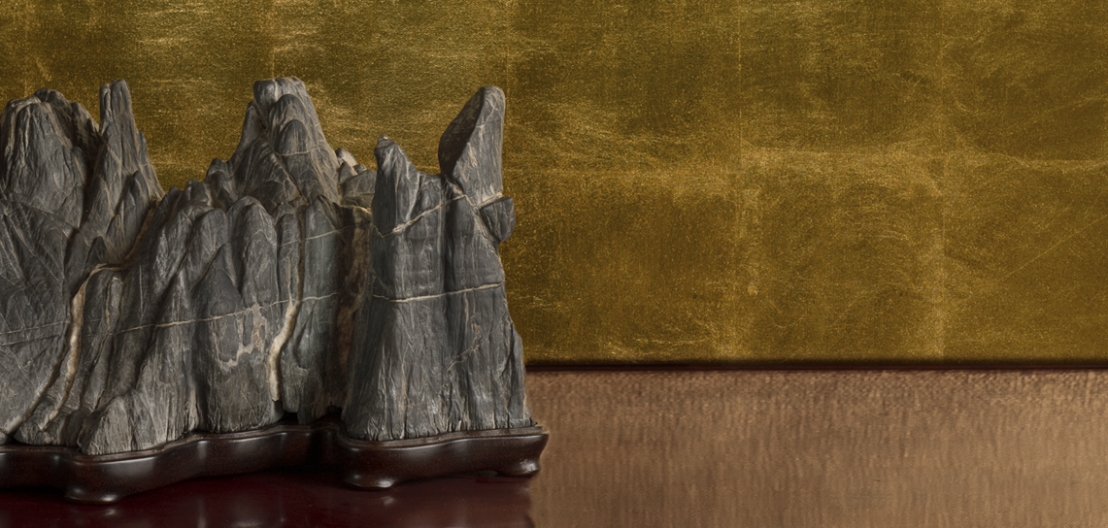
Suiseki (Jap. ‘water and stone’) is an art of Chinese origin, consisting in artistic display of stones whose shape or texture reflects an existing landscape or other natural features. The tradition has a long history, going back to the Kamakura period (1192–1333) in Japan. One of the most popular forms of suiseki is toyamaishi (‘distant mountain’), i.e. a stone representing a single mountain or several pinnacles. Other frequent natural features are waterfalls, bodies of water, plateaus, or islands. In addition to such landscape motifs, suiseki also involves shapes representing picturesque details: the worn thatch of an alpine cottage or a boat abandoned at water’s edge; there are also stones resembling animals or human figures; yet another category comprises ones with a floral pattern or other natural elements seen on their surface.
At the Manggha Museum, suiseki began to surface in the late 1990s, although the breakthrough did not come until the autonomous International Suiseki Exhibition in 2012, with contributing collectors from Slovakia and the Czech Republic. The show was also graced by Master Matsuura (the world’s greatest authority on this art and for years the leader of the Nippon Suiseki Association), who showed much appreciation for it, despite the highly intuitive work that had gone into creating it. Soon thereafter, the exhibition participants came up with the idea to create a group of leaders with a view to teaching and propagating the Japanese art of suiseki in the three countries: Slovakia, the Czech Republic, and Poland. The project – and the group that created it – were named Sanseki (‘Three Stones’). Their efforts culminate in a suiseki exhibition held annually in one of the contributing countries.
Suiseki is a manifestation of the wabi-sabi aesthetic, the Japanese idea of beauty derived from Zen philosophy, also found e.g. in the tea ceremony (chado) or haiku poetry. Contemplating the subdued colours and the suggestive-yet-harmonious and subtle forms of stones makes it possible to notice their outer and inner beauty – the beauty which, after all, is ‘in the eye of the beholder’. It helps understand the spirit and essence of Japan’s tradition and culture. The exhibition is a fitting contribution to the theme of nature, which has a persistent and pervasive presence at the Manggha Museum.
The Suiseki Exhibition scheduled for 2025 is composed of two parts: the 12th International Sanseki Exhibition and the 1st National Suiseki Exhibition. The results of the efforts made by the practitioners of this art are going to be showcased for the first time in the Europe–Far East Gallery. The first part of the show (on the ground floor) draws upon the classical methods of displaying stones. The visitors will be able to discover the secrets of this extraordinary art by following paths marked by tatami mats. The unhurried contemplation and exploration of the suiseki tradition will be enhanced not only by the subtle earth-toned visual narrative but also by a musical score composed specifically for this occasion. Polish suiseki collectors’ exhibits will be displayed on the upper floor. This is the first presentation of its kind in Poland. In this part of the exhibition, the viewers will be invited to carefully examine the objects from every angle and to walk into a kind of audiovisual ‘stone’ constellation.